
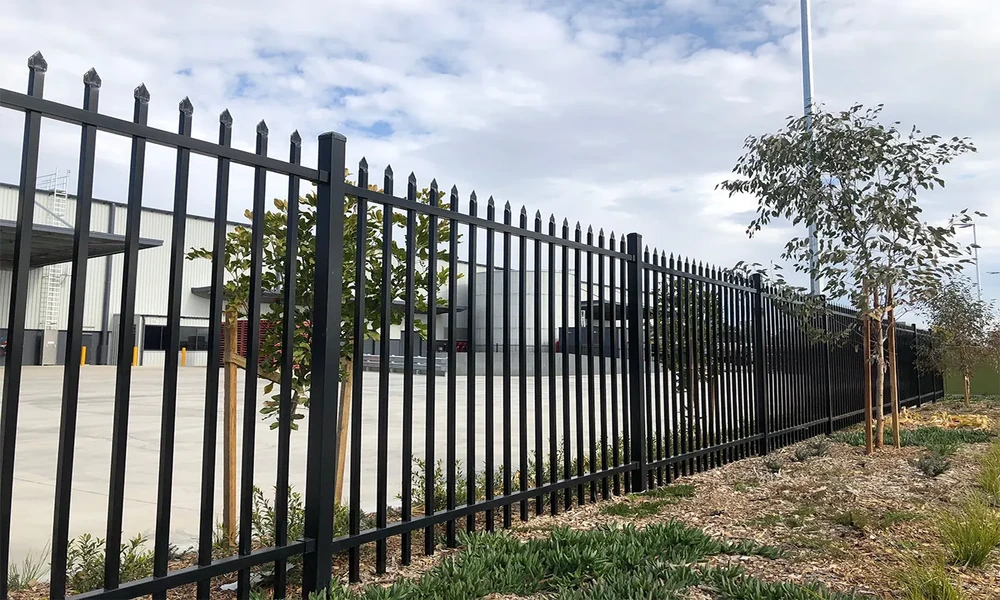
There are many more uses for commercial fences than just marking the boundaries of different properties. Fencing may help with security, access control, aesthetics, and general site organization around industrial buildings, warehouses, utility sites, corporate assets, transportation facilities, and other commercial places. The quality of the materials used during production might have a big impact on these systems’ long-term performance since they could be in use for many years.
For this reason, selecting a commercial fence manufacturer necessitates considering factors beyond the initial cost and style of the fence. The effectiveness of a fence following installation is influenced by material selection, fabrication standards, protective coatings, and structural consistency.
The Material Is The First Step In Structural Strength
Over the course of its useful life, a commercial fence may be subjected to harsh environments. A fence system may progressively become stressed by wind, unintentional accidents, frequent usage near gates, temperature changes, and regular exposure to the environment.
The structural framework required to handle these circumstances is provided by high-quality steel and other carefully chosen materials. For the intended use, posts, rails, panels, pickets, and connecting points must all have the appropriate strength. The final fence may be more susceptible to bending, movement, or early degradation if weaker materials are utilized to save production costs.
Therefore, rather than just fulfilling fundamental visual expectations, material requirements should represent the project’s context and goal.
Longevity Is Supported By Corrosion Resistance
Outdoor metal items are continuously exposed to environmental elements such as moisture, humidity, precipitation, and contaminants. Corrosion may progressively deteriorate both appearance and structural integrity in the absence of sufficient protection.
By using protective treatments and appropriate material selection, manufacturing processes may mitigate this danger. For instance, properly applied coating systems and galvanization may help provide barriers between metal surfaces and environmental exposure.
The quality of manufacture also affects how effective these safeguards are. Weak or insufficient covering might expose sensitive regions; thus, it’s important to prepare the surface properly and apply the coating consistently.
Longer-lasting corrosion resistance may result in less maintenance and a more stable look over time for property owners.
Manufacturing Precision Is Enhanced By Material Consistency
The strength of individual components is not the sole factor that determines quality. When building whole commercial fence systems, consistency is just as crucial.
Manufacturers may maintain more consistent dimensions, welds, connections, and finishes by using uniform materials. On big projects, where hundreds of discrete components may need to align perfectly over a wide perimeter, this becomes very crucial.
Reliable production tolerances might result in a cleaner final product while increasing installation efficiency. Properly aligned panels, consistently sized posts, and precisely constructed connecting points may minimize needless field modifications.
Security Is Not Just Affected By Fence Height
Strong perimeter security is not often provided by a tall fence. The system’s building materials and techniques are equally crucial.
Fencing intended to deter climbing, endure physical pressure, or work with gates and restricted entrance points may be necessary for commercial and industrial premises. Material strength is included in the overall security plan in these circumstances.
A commercial fence manufacturer may develop systems with a variety of configurations in accordance with the security requirements of the project. A more reliable perimeter may be created using heavy-duty steel components, safe connections, well-planned spacing, and suitable gate systems.
These factors become particularly crucial for higher security sites since system performance might be impacted by flaws in individual components.
Appearance Matters On Commercial Properties
Commercial fencing is often quite noticeable. The fence around workplaces, public buildings, residential complexes, academic campuses, and other notable structures may affect the site’s first impression.
A more consistent basis for construction and finishing is usually provided by high-quality materials. A professional look is aided by straight parts, uniform spacing, seamless connections, and long-lasting coatings.
Therefore, an architectural fence may meet security needs without giving a home too industrial an appearance. While preserving the structural qualities necessary for commercial usage, manufacturers may design systems that blend in with nearby structures.
Conclusion
Almost every significant aspect of commercial fencing is influenced by material quality, including appearance, security, and maintenance needs in addition to structural strength and corrosion resistance. Additionally, careful material selection provides producers with a more solid basis for accurate construction and reliable performance.
Examining material specifications may be as crucial for commercial property owners, contractors, architects, and facility planners as choosing a fence design. Purchasing components that are made correctly contributes to the creation of a perimeter system that will continue to be secure, practical, and aesthetically pleasing for many years to come.


